
Extreme Reactions
Calls grow for speed-limiting technology as police catch thousands of drivers driving at significantly excessive speeds


Road safety organisations are stepping up calls for mandatory speed-limiting technology for repeat offenders.
New figures reveal hundreds of thousands of motorists were caught driving at dangerously excessive speeds on Britain’s lower-speed roads.
Speeding on urban roads is a particular concern as it results in more serious casualty consequences.
Urban chaos
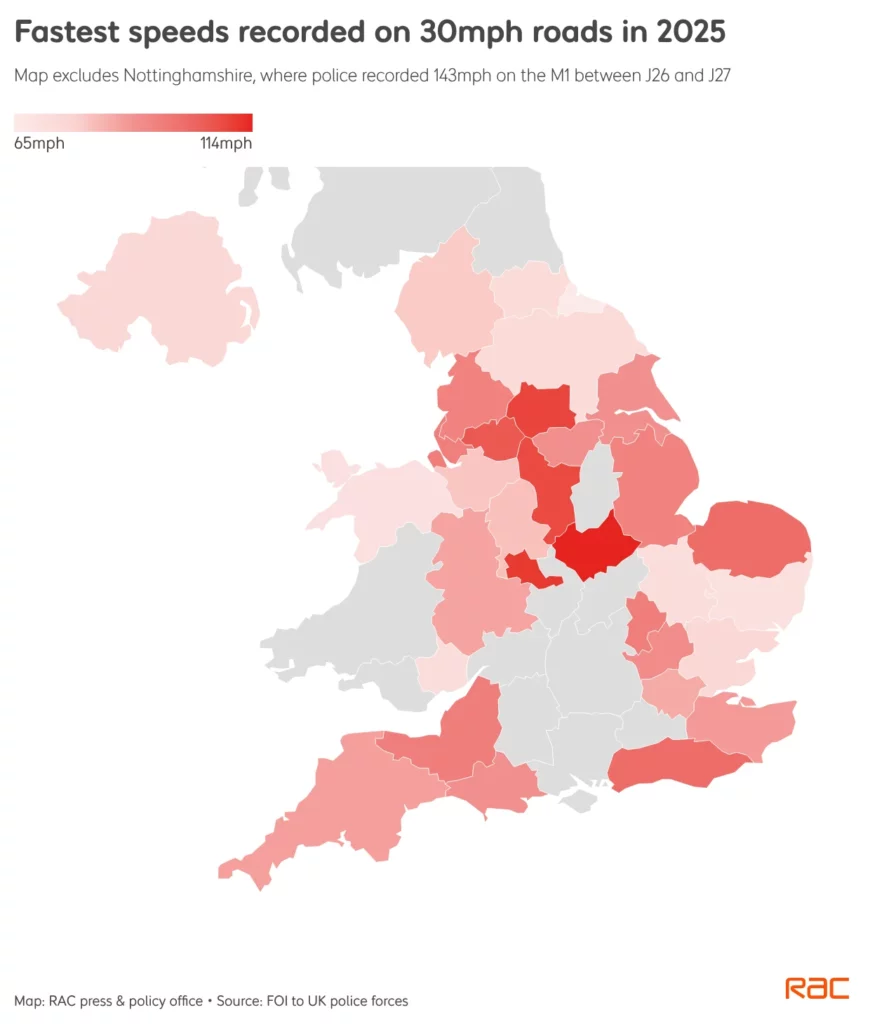
New analysis by the RAC, based on Freedom of Information requests to 33 police forces, found more than 271,000 drivers were caught travelling at 40mph or above in 30mph limits during 2025.
Meanwhile, almost 33,000 motorists were detected driving at 30mph or more in 20mph zones.
Among the most shocking offences were a driver clocked at 114mph in a 30mph limit in Leicestershire and another travelling at 89mph on a 20mph road in north Wales.
Other motorists were recorded at 80mph near schools in Cheshire and at 79mph on a residential road in Cumbria during the afternoon, when vulnerable road users were likely to have been present.
The RAC says the figures demonstrate that excessive speeding remains a significant road safety problem despite years of enforcement and public education campaigns.

Persistent danger
Official Department for Transport data shows speed remains one of the biggest contributory factors in fatal collisions.
In 2024, excessive or inappropriate speed was recorded as a contributory factor in 58% of fatal crashes, while drivers exceeding the speed limit were involved in one in five fatal collisions.
A total of 185 people died in crashes where breaking the speed limit was identified as a factor.
The latest figures also reinforce previous RAC research suggesting speeding has become increasingly normalised.
Four in five drivers say they regularly witness excessive speeding on 20mph and 30mph roads, while 55% believe there is now a “culture of speeding” in the UK.
Separate RAC research found that 86% of motorists support tougher measures to tackle persistent speeders.
Separate research last Autumn found that 86% of drivers polled support new measures to combat excessive speeding, with 55% strongly supporting action.
Horror show
Rod Dennis, the RAC’s senior policy officer, described some of the recorded speeds as “frankly chilling”.
“The fact that some were recorded in residential areas, even near schools, during daytime hours underlines just how dangerous this kind of behaviour is,” he said.
“There is a great deal of work still to do. Speeding is a choice, and far too many fatal collisions remain entirely preventable.”
The motoring organisation is backing the Stop Excessive Speeders campaign, which calls on the Government to require repeat speeding offenders to fit Intervening Intelligent Speed Assistance (IISA) technology in their vehicles.
Unlike advisory Intelligent Speed Assistance systems now fitted to new cars, IISA actively limits throttle input to prevent drivers from exceeding the posted speed limit, although it can be overridden in limited circumstances.
Will they learn
For driver trainers, speeding remains a prominent focus in road safety education, but the concern is how well the advice is sinking in, especially among young male drivers.
While learner drivers generally demonstrate good compliance with speed limits during lessons and tests, instructors have long warned that attitudes towards speed often change after passing the driving test, influenced by peer pressure, overconfidence and habit.
It was hoped that telematics, or ‘black box’ insurance, would play a greater role in curbing excessive speeding in the early years of driving, but take-up remains below expectations despite the premium cost savings.
Graduated Driver Licensing (GDL), if made mandatory, would also be expected to curb poor attitudes to speeding in the crucial early years, but the Government continues to rule out its introduction in the UK.
While speeding remains a problem across all age groups, it is believed that setting the best, safest attitudes in the early years is key.
Catch them if you can
Recent research from Marshall Motor Group suggests enforcement activity is also increasing.
Data obtained from 30 police forces found that almost 286,000 more speeding offences were detected on 20mph and 30mph roads in 2025 than in 2023, with more than 317,000 offences recorded during the first three months of 2026 alone — equivalent to more than 3,500 offences every day.
Offences on lower-speed roads increased by almost 26% over three years.
The RAC is backing a new Stop Excessive Speeders campaign, calling on the Government to introduce Intervening Intelligent Speed Assistance technology to help prevent reoffending.
Devon and Cornwall Police recorded more speeding offences on 20mph and 30mph roads than any other responding force between 2023 and 2025.
The force recorded 351,015 offences between 2023 and 2025 – equivalent to around 320 speeding offences every day across the three years.
Of those, 297,405 offences were recorded on 30mph roads, while a further 53,610 were recorded in 20mph limits.
Greater Manchester Police recorded the second-highest total with 280,282 offences, followed by Nottinghamshire Police with 247,100.
Police force areas recording the most speeding offences between 2023 and 2025
- Devon and Cornwall Police – 351,015
- Greater Manchester Police – 280,282
- Nottinghamshire Police – 247,100
- West Midlands Police – 242,337
- West Mercia Police – 223,016
- Thames Valley Police – 197,226
- Avon and Somerset Constabulary – 194,968
- Merseyside Police – 154,582
- Lancashire Constabulary – 143,602
- Leicestershire Constabulary – 140,934
Source: Marshall Motor Group
Cultural change
National Police Chiefs’ Council roads policing lead Chief Constable Jo Shiner said the findings reflected an entrenched behavioural problem.
“The fact that a majority of drivers now believe there is a culture where speeding is acceptable reflects a deeply embedded issue in driver behaviour,” she said. “We must reset expectations and make it clear that safe, lawful driving is a shared responsibility.”
Road Safety GB has consistently argued that enforcement alone cannot solve the problem, calling for a “safe system” approach combining road design, education, technology and policing.
Similarly, the Parliamentary Advisory Council for Transport Safety (PACTS) has previously supported wider use of Intelligent Speed Assistance, describing the technology as one of the most effective interventions available to reduce collisions caused by excessive speed.
Your number’s up
The Government has acknowledged speeding as one of the “fatal four” road safety risks in its developing Road Safety Strategy and has committed to new casualty reduction targets.
Ministers are also reviewing responses to consultations on local speed limits and future road safety measures.
However, they have yet to indicate whether mandatory speed-limiting technology for repeat offenders will form part of future policy.
For the driver training industry, the latest figures provide a stark reminder that developing safe attitudes towards speed must remain a priority long after learners have mastered the mechanics of vehicle control.
As the evidence continues to mount, many road safety organisations believe technology will increasingly need to complement education if the UK’s stubbornly high toll of speed-related casualties is to be reduced.